AI in Business · July 21, 2026
Where does AI really stand?
From Eliza to the NEO robot
It took AI sixty years to learn how to talk — and three more to grow hands. A field report from our AI Business Community, recorded on July 17, 2026 (full video included, in German).
Friday, 1 p.m., a Zoom call full of entrepreneurs. On screen: a humanoid robot tidying up a household. Then a psychiatrist in the group speaks up: “I find this genuinely impressive. But who is going to care for the elderly one day — and would I rather talk to a robot or to a human being?”
That question landed in the middle of the first session of our AI Business Community on July 17, 2026. It is no longer a science-fiction question. To understand why it comes up right now, it helps to look back — because the history of AI is both shorter and slower than most people assume.
Sixty years of run-up: AI's short history
In the mid-1960s, MIT researcher Joseph Weizenbaum wrote a small program called ELIZA. At its core it could do exactly one thing: turn statements into questions. “Nice weather today.” — “What do you find nice about this weather?” Sprinkle in a few generic proverbs, and that was it. Yet people came out of sessions convinced they had just had a meaningful conversation.
With that, ELIZA touched the question Alan Turing had posed back in 1950: can a human tell whether they are talking to a machine or to another human? The famous Turing test. Machine learning followed in the 1980s — for decades a research discipline hardly anyone outside universities noticed.
Then, at the end of 2022, the moment everyone remembers: ChatGPT. For the first time, anyone could talk to an AI and get something genuinely useful back. What tends to be overlooked is what happened next: almost three years in which, essentially, only the text got better. The AI talked more cleverly — but it kept talking. It could not open a file, run a process or operate a tool.
2026: the year AI grew hands
In early 2026 that boundary fell. The new AI systems gained access to files and the internet — in our community we call these the “electronic hands and feet”. Since then, AI no longer merely talks about work; it does the work: reading and writing documents, uploading videos, pulling transcripts, operating other software through interfaces. The conversation partner became an agent.
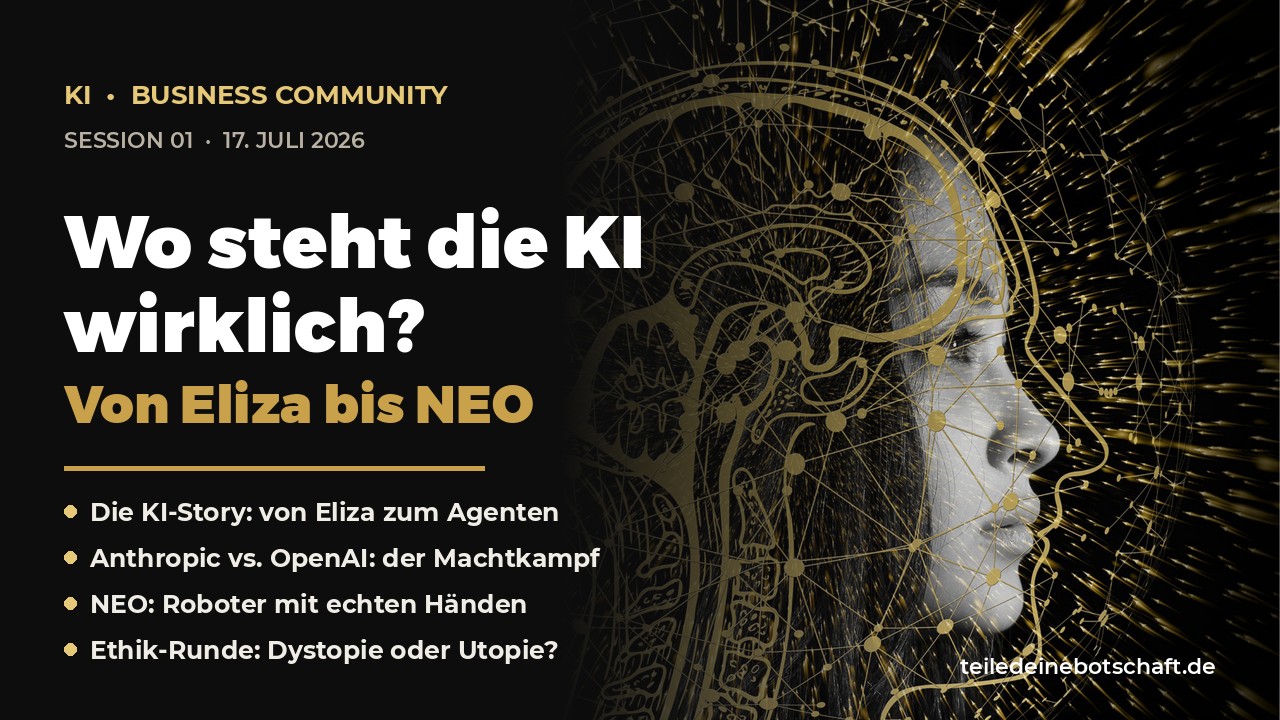
At the same time, Anthropic and OpenAI are locked in a head-to-head race that produces new models almost weekly — currently ChatGPT 5.6 and the Codex tools on one side, the Claude family on the other — while China pushes tens of thousands of freely available open-source models into the market. The full background of that power struggle, including the question of whether the strongest models will ever reach ordinary users, is covered in the session video (in German):
Humanoid robots: NEO and the bottleneck of hands
And now AI is growing real hands. Humanoid robots are where software and motors are merging — and the bottleneck is not what most people expect. Walking has long been solved. So has power: in early factory deployments, robots swap their own batteries. The real bottleneck is touch.
Pick up a cup. How do you know whether it is full or empty? How firmly may you grip it so it neither slips nor breaks? Your brain answers this in milliseconds. For machines, precisely this was out of reach for decades. The new NEO by Norwegian manufacturer 1X is the first model whose hands come seriously close to human fine motor skills — in the session video you can watch it load laundry, grip glasses and open doors.
The human shape, by the way, has little to do with engineering. A spider with eight gripping arms would probably be more practical — but nobody wants a hip-high spider in their living room. The humanoid form is psychological acceptance, not engineering logic. Gregor's assessment from the session: we still think in years for household robots, while realistically we are talking months, at price points already comparable to a small car.
Dystopia or utopia? The group debates
Back to the psychiatrist's question. She was not alone: who cares for the elderly? What does this do to relationships? A physician in our group added a thought that stuck: perhaps real time with real humans will become one of the most precious things we can share — especially in therapy and coaching.
What stands out is how one-sided we discuss such shifts. We write the dystopia in capital letters and barely mention the utopia. Yet the other side is just as real: a robot watching the pool while your children swim. Playing the piano in the evening. Taking over the routine tasks in elderly care that leave no time for conversation today — so that humans have time for conversations again. The truth, as usual, will sit somewhere between the two pictures.
One image from the session makes it tangible: handwritten letters did not disappear when email arrived. They became rare — and precisely through that, meaningful. A handwritten love letter weighs more today than fifty years ago. The human element will not vanish as machines arrive. It will become more precious.
What this means for your business: engine, structure, focus
You can find all of this fascinating or unsettling — what counts is what you, as an entrepreneur, do with it. A comparison sorts it out: AI in business is like driving a car. You need to know where the pedals and the tank are. You do not need to build the engine. But the best car is worthless if you cannot drive.
Almost everyone out there talks about the engine: models, benchmarks, features. Hardly anyone talks about the driving. Yet that is exactly where the new problems appear once AI genuinely works inside a company. Two of them decide between results and expensive chaos:
Structure. AI amplifies whatever it finds — including disorder. If you work without structure, AI helps you produce more mess, faster. Used well, it works the other way round: clear filing, documented processes, solid knowledge management — AI can even build that structure for you, up to automated project management.
Focus. AI makes you many times faster. The entrepreneurial question is: faster — towards what? Riding a rocket without a destination only gets you to the wrong place sooner. Destination and sequence first, tools second. Otherwise AI remains an engine revving in neutral.
This is the mindset behind everything we do at Teile Deine Botschaft: we help experts and entrepreneurs build an online business with AI as the foundation — not as a gadget. Our success stories and the TDB book show what that looks like in practice.
Staying current without reading news every day
The psychiatrist from the opening wrote one more line at the end of the session: it helped her overcome her fear of these technologies. That is the whole point. Not chasing every headline — but sorting, every two weeks in a single hour, what matters, what is hype, and what you can concretely use in your business.
That is what the AI Business Community is for: live every other Friday, 1–2 p.m. German time — 30 minutes of “what is moving in the market”, 30 minutes of use cases and best practices from the group. The sessions are held in German. If you want to join the next one: membership is 27 € per month (plus VAT), cancellable monthly.
AI Business Community
Know what matters every two weeks — instead of chasing news every day.
Live every 14 days, Friday 1–2 p.m. (German time, sessions in German) · recordings included · 27 €/month plus VAT, cancellable monthly. Next session: July 31, 2026.
Frequently asked questions about the state of AI in 2026
How far along are humanoid robots in 2026, really?
Walking, gripping, even swapping their own batteries: humanoid robots can do all of that in 2026. The bottleneck is touch — hands that can feel whether a cup is full or slipping. That is exactly where new models such as NEO by 1X come in. Factories are running first pilots, and the household market is being planned in earnest.
What is the difference between ChatGPT and an AI agent?
A chat model answers questions — it talks. An AI agent has access to files, the internet and tools: it reads, writes, uploads, operates other software and completes processes on its own. AI took that step in early 2026, and it changes day-to-day business work far more than any model update.
Do I need to master AI technology as an entrepreneur?
About as much as you need to master your car: you should know where the pedals and the tank are — you do not need to build the engine. The basics (context, agents, data protection) are mandatory. What decides the outcome afterwards is the driving: applying AI to your own business with structure and a clear destination.
How do I keep up with AI without drowning in news?
Do not chase every headline. Review the landscape every two weeks with a filter: what matters, what is hype? And hold on to two principles — structure (AI amplifies chaos, too) and focus (destination first, tools second). That rhythm is exactly what our AI Business Community delivers in one live hour every other week.
Published July 21, 2026. The AI world moves fast — numbers, model names and market positions may have changed since. Market details in the video reflect Gregor's assessment during the session.